
By Tiffanni Hernandez on Jun 08, 2026

If you're exploring alternatives to traditional bank financing, you've likely come across both merchant cash advances (MCAs) and revenue-based financing (RBF). They might sound similar, both provide fast capital tied to business performance but they work very differently.
Understanding these differences can save your business thousands of dollars and protect your cash flow.
Many business owners turn to MCAs thinking they're a quick fix only to realize too late how expensive daily deductions can be. Revenue based funding is often positioned as "similar but better," yet the differences aren't always obvious at first glance.
What's the difference between MCAs and revenue-based financing?
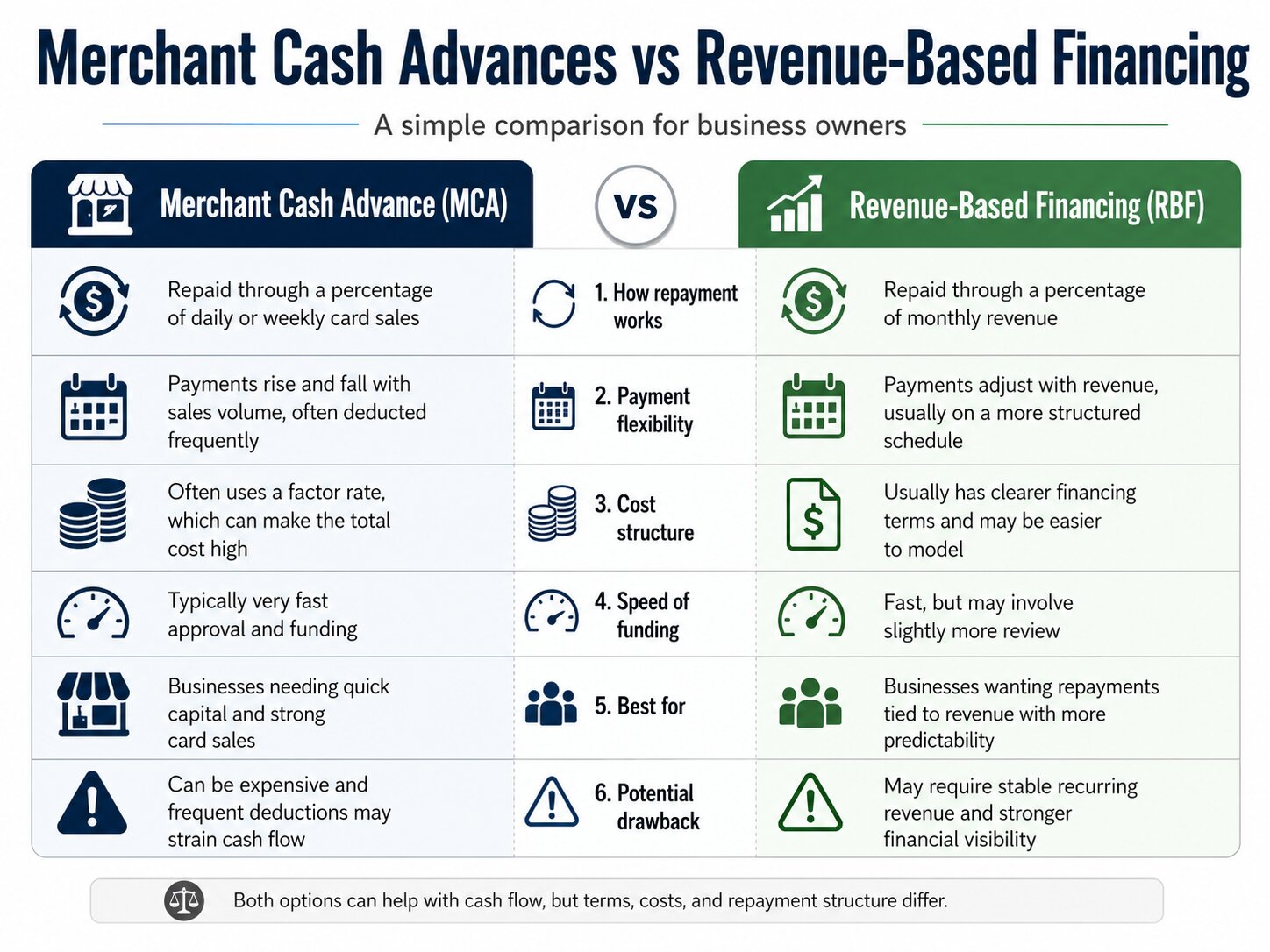
At a glance, both options are based on your business’s revenue profile, but the structure, cost, and impact on your daily operations are significantly different.
The bottom line: Both MCAs and revenue-based financing offer fast access to capital. The difference is in how repayment works. MCAs typically use fixed daily or weekly withdrawals that can strain cash flow, while revenue-based financing is structured with a defined payment and flexibility during slower periods helping you maintain control when your business needs it most.
What this actually looks like in real life
On paper, merchant cash advances (MCAs) and revenue-based financing can look very similar. Both offer fast access to capital, and in many cases, the total repayment and initial payment amounts may be comparable.
The real difference shows up in how repayment is handled when your business doesn't perform exactly as expected.
Scenario 1: The post-holiday slowdown
It's mid-January. Your business just came off a strong holiday season, but revenue has dropped 30 - 40% as things normalize. Cash flow is tighter than usual, and you're managing payroll, inventory, and fixed expenses.
- With an MCA: Payments typically continue at the same daily or weekly amount. If the slowdown creates strain, you may be able to request temporary relief but any adjustment is handled at the provider's discretion and isn't guaranteed as part of the agreement.
- With revenue-based financing: You can request a review based on your recent revenue trends. If your business is in a slower period, payments can be adjusted to better reflect current performance helping you maintain stability without overextending your cash flow.
Scenario 2: An unexpected disruption
Your business experiences an unexpected issue: equipment downtime, staffing shortages, or a temporary closure leading to a short-term drop in revenue.
- With an MCA: Fixed payments typically continue as scheduled. In some cases, providers may offer short-term accommodations, but this is evaluated case-by-case and depends on the provider.
- With revenue-based financing: The ability to request adjustments is built into the structure. Based on updated performance, payments can be modified to help you navigate the disruption without creating additional financial pressure.
Scenario 3: Normal operations
When business is steady and performing as expected, both options can feel very similar.
- With an MCA: Payments continue at a fixed, predictable amount until the obligation is satisfied.
- With revenue-based financing: Payments follow a defined structure under normal conditions, with the added benefit of flexibility if business conditions change.
Why this matters
Both MCAs and revenue-based financing provide speed. The difference is in how repayment is supported over time.
With an MCA, flexibility may be available but it depends on the provider.
With revenue-based financing, you have a clear path to request adjustments if your business slows down, giving you a more predictable and dependable way to manage payments as your business evolves.
How Magenta's revenue-based financing works
Magenta provides revenue-based financing — a funding solution designed to give businesses fast access to capital with a clear, structured approach to repayment.
Unlike traditional financing that relies heavily on credit scores and collateral, Magenta evaluates your business based on what matters most: your revenue, performance, and overall stability.
What you get with Magenta
How repayment works
Magenta's financing is structured with a defined payment amount based on your business profile and revenue at the time of approval.
Under normal conditions, payments remain consistent and predictable allowing you to plan around a known obligation.
If your business experiences a slowdown, you can request a review. Based on your recent revenue trends, adjustments may be approved to better reflect the temporary change in performance.
In addition, many clients have the option to pay off early, with potential savings depending on timing providing added flexibility beyond the standard payment structure.
This creates a balance between structure and flexibility giving you clarity upfront, with a dependable path to support when your business needs it.
Why business owners choose Magenta
Speed without trade-offs
Magenta moves as quickly as traditional MCA providers with decisions typically within an hour and funding available as soon as the same day or next business day.
A defined structure you can plan around
Your total repayment is clearly established upfront, with a consistent payment structure designed to remain stable under normal conditions.
Flexibility when it matters
If your business slows down, you have a clear process to request adjustments based on performance rather than relying entirely on discretionary relief.
Accessible approval approach
Approval is based on your business's revenue and performance, not just your credit profile opening the door for businesses that may not qualify through traditional channels.
Clarity from the start
You know exactly what you're agreeing to — with clear terms and a defined total cost
Real example
A waterfront restaurant in Naples, Florida built a strong following around its outdoor patio — especially during peak season.
Based on consistent performance, the business was approved for revenue-based financing with a defined weekly payment structure.
Unexpectedly, a stretch of cooler weather moved in, keeping customers away and reducing revenue below typical levels for several weeks.
Instead of trying to push through the dip, the owner reached out to their dedicated funding specialist, Lauren.
Lauren reviewed the request and submitted it for evaluation based on the restaurant's recent revenue trends. The business was approved for a temporary 3-week payment reduction, helping ease pressure during the slower period.
As the weather improved, regular customers returned, patio traffic picked back up, and the restaurant resumed its original payment structure.
The business stayed stable not because revenue never fluctuated, but because it had a structure in place that allowed for support when it mattered.
Ready to see what you qualify for?
If you're tired of financing options that work against your cash flow, Magenta's revenue-based financing might be the solution you've been looking for.
Here's how to get started:
Option 1: Check your eligibility in minutes. Use Magenta's funding calculator to see what you might qualify for based on your business revenue. No commitment, no credit check — just a quick estimate to help you plan.
Option 2: Talk to a funding advisor. Have questions? Want to understand how revenue-based financing would work for your specific situation? Connect with a dedicated Magenta funding advisor who can walk you through your options.
Option 3: Apply now. Ready to move forward? Start your application — most businesses receive offers within an hour, with funding available as soon as the same day.
Invest in Possible.
Magenta Guide: Bank Loans vs Alternative Financing

Empowering Trucking Businesses with Flexible Financing